QP 01
A curve is such that \(\dfrac{dy}{dx} = 2x^2 \:-\:5\). Given that the point (3, 8) lies on the curve, find the equation of the curve.
[showhide type=”1″ more_text=”Show Solution” less_text=”Hide Solution” hidden=”yes”]
[su_table responsive=”yes”]
\(y = \int 2x^2\:-\:5 \: dx\)
\(y = \dfrac{2}{5}x^3\:-\:5x + c\)
Since (3, 8) lies on the curve the coordinates must satisfy the equation:
\(8 = \dfrac{2}{3}(3)^3\:-\:5 \cdot 3 + c\)
\(8 = 18 \:-\:15 + c\)
\(8 = 3 + c\)
\(c = 5\)
Therefore the equation of the curve is:
\(y = \dfrac{2}{5}x^3\:-\:5x + 5\)
[/su_table]
[/showhide]
[su_divider top=”no” size=”1″]
QP 02
Find the gradient of the curve \(y = \dfrac{12}{x^2\:-\:4x}\) at the point where \(x = 3\).
[showhide type=”2″ more_text=”Show Solution” less_text=”Hide Solution” hidden=”yes”]
[su_table responsive=”yes”]
\(y = 12(x^2\:-\:4x)^{-1}\)
\(\dfrac{dy}{dx} = -12(x^2\:-\:4x)^{-2} \cdot (2x\:-\:4)\)
\(\text{gradient}\:(m) = \dfrac{dy}{dx}\)
\(m = -12(2x\:-\:4)(x^2\:-\:4x)^{-2}\)
The gradient of the curve \(y\) at the point where \(x = 3\) is:
\(m = -12(2(3)\:-\:4)(3^2\:-\:4(3))^{-2}\)
\(m = -12(2)(-3)^{-2}\)
\(m = \dfrac{-24}{9}\)
\(m = -\dfrac{8}{3}\)
[/su_table]
[/showhide]
[su_divider top=”no” size=”1″]
QP 03
(i) Show that the equation \(\sin \theta + \cos \theta = 2(\sin \theta \:-\: \cos \theta)\) can be expressed as \(\tan \theta = 3\).
(ii) Hence solve the equation \(\sin \theta + \cos \theta = 2(\sin \theta \:-\: \cos \theta)\), for \(0^{\circ} \leq \theta \leq 360^{\circ}\)
[showhide type=”3″ more_text=”Show Solution” less_text=”Hide Solution” hidden=”yes”]
[su_table responsive=”yes”]
(i) \(\sin \theta + \cos \theta = 2\sin \theta \:-\: 2\cos \theta\)
\(2\cos\theta + \cos \theta = 2\sin \theta \:-\: \sin \theta\)
\(3\cos \theta = \sin \theta\)
\(\dfrac{\sin \theta}{\cos \theta} = 3\)
\(\tan \theta = 3\)
(ii) \(\tan \theta = 3\), for \(0^{\circ} \leq \theta \leq 360^{\circ}\)
\(\tan \theta = \tan 71,6^{\circ}\)
\(\theta =71,6^{\circ} + k \cdot 180^{\circ}\)
\(\text{for } k = 0 \rightarrow \theta = 71,6^{\circ} \)
\(\text{for } k = 1 \rightarrow \theta = 251.6^{\circ}\)
Solution:
\(\lbrace 71,6^{\circ}, 251.6^{\circ}\rbrace\)
[/su_table]
[/showhide]
[su_divider top=”no” size=”1″]
QP 04
(i) Find the first 3 terms in the expansion of \((2\:-\:x)^6\) in ascending powers of \(x\)
(ii) Find the value of \(k\) for which there is no term in \(x^2\) in the expansion of \((1 + kx)(2\:-\:x)^6\)
[showhide type=”4″ more_text=”Show Solution” less_text=”Hide Solution” hidden=”yes”]
[su_table responsive=”yes”]
(i) \((a \:-\: b)^6 = a^6 \:-\: 6a^5b + 15a^4b^2 \:-\: \dotso\)
\((2\:-\:x)^6 = 2^6 \:-\:6\cdot 2^5 \cdot x + 15 \cdot 2^4 \cdot x^2 \:-\: \dotso\)
\((2\:-\:x)^6 = 64 \:-\:192x + 240x^2 \:-\: \dotso\)
The first 3 terms in the expansion of \((2\:-\:x)^6\) in ascending powers of \(x\) is
\(64 \:-\:192x + 240x^2\)
(ii) \((1 + kx)(2\:-\:x)^6\)
\((1 + kx)(64 \:-\:192x + 240x^2 \:-\: \dotso)\)
There is no term in \(x^2\):
\(240x^2 \:-\: 192kx^2 = 0\)
\(240 = 192k\)
\(k = \dfrac{240}{192}\)
\(k = \dfrac{5}{4}\)
[/su_table]
[/showhide]
[su_divider top=”no” size=”1″]
QP 05
[su_table responsive=”yes” alternate=”no”]
[/su_table]
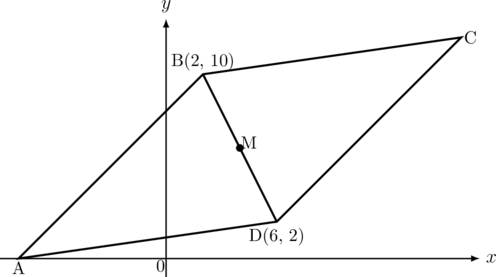
The diagram shows a rhombus ABCD. The points B dan D have coordinates (2, 10) and (6, 2) respectively, and A lies on the x-axis. The mid-point of BD is M. Find, by calculation, the coordinates of each of M, A and C.
[showhide type=”5″ more_text=”Show Solution” less_text=”Hide Solution” hidden=”yes”]
[su_table responsive=”yes”]
BD ⊥ AC
B(2, 10) and D(6, 2)
Mid-point of BD is M
\(\text{M} \left(\dfrac{x_1 + x_2}{2}, \dfrac{y_1 + y_2}{2}\right)\)
\(\text{M} \left(\dfrac{2 + 6}{2}, \dfrac{10 + 2}{2}\right)\)
\(\color{red} \text{M} (4, 6)\)
\(\text{Gradient } BD = \dfrac{10\:-\:2}{2\:-\:6}\)
\(m_{BD} = \dfrac{8}{-4}\)
\(m_{BD} =-2\)
\(m_{BD} \cdot m_{\text{AC}} = -1\)
\(-2 \cdot m_{AC} = -1\)
\(m_{AC} = \dfrac{1}{2}\)
Equation of AC:
\(y\:-\:y_1 = m(x\:-\:x_1)\)
\(y\:-\:6 = \dfrac{1}{2}(x\:-\:4)\)
\(y = \dfrac{1}{2}x \:-\:2 + 6\)
\(y = \dfrac{1}{2}x + 4\)
A lies on the x-axis, coordinate A(x, 0)
\(0 = \dfrac{1}{2}x + 4\)
\(-4 = \dfrac{1}{2}x\)
\(x = -8\)
A(-8, 0)
Use translations
C(16, 12)
[/su_table]
[/showhide]
[su_divider top=”no” size=”1″]
QP 06
A geometric progression has 6 terms. The first term is 192 and the common ratio is 1.5. An arithmetic progression has 21 terms and common difference 1.5. Given that the sum of all the terms in the geometric progression is equal to the sum of all the terms in the arithmetic progression, find the first term and the last term of the arithmetic progression.
[showhide type=”6″ more_text=”Show Solution” less_text=”Hide Solution” hidden=”yes”]
[su_table responsive=”yes”]
Geometric progression (GP)
\(n = 6\)
\(a = 192\)
\(r = 1.5\)
Arithmetic progression (AP)
\(n = 21\)
\(d = 1.5\)
The sum of all the terms in the geometric progression is equal to the sum of all the terms in the arithmetic progression.
\(S_{6} \text{ in GP} = S_{21} \text{ in AP}\)
\(\dfrac{192(1.5^6\:-\:1)}{(1.5\:-\:1)} = \dfrac{21}{2}(2a + (21\:-\:1)\cdot 1.5) \)
\(\dfrac{192(1.5^6\:-\:1)}{0.5} = \dfrac{21}{2}(2a + 30) \)
\(384 \cdot \dfrac{665}{64} = 21a + 315 \)
\(3990 = 21 a + 315 \)
\(21 a = 3675\)
\(a = 3675 \cdot \dfrac{1}{21}\)
\(a = 175\)
The first term of the arithmetic progression = 175
\(21^{\text{st}}\) term in AP = \(U_{21}\)
\(U_{\text{n}} = a + (n \:-\:1)\cdot d\)
\(U_{21} = 175 + (21 \:-\:1)\cdot 1.5\)
\(U_{21} = 175 + 30\)
\(U_{21} = \color{red} 205\)
[/su_table]
[/showhide]
[su_divider top=”no” size=”1″]
QP 07
A function \(f\) is defined by \(f : x \rightarrow 3 \:-\: 2 \sin x\), for \(0^{\circ} \leq x \leq 360^{\circ}\).
(i) Find the range of \(f\)
(ii) Sketch the graph of \(y = f(x)\)
A function \(g\) is defined by \(g : x \rightarrow 3 \:-\:2\sin x\), for \(0^{\circ} \leq x \leq A^{\circ}\), where \(A\) is a constant.
(iii) State the largest value of \(A\) for which \(g\) has an inverse.
(iv) When \(A\) has this value, obtain an expression, in terms of \(x\), for \(g^{-1}(x)\).
[showhide type=”7″ more_text=”Show Solution” less_text=”Hide Solution” hidden=”yes”]
[su_table responsive=”yes”]
Solution for (i)
Domain (daerah asal): \(0^{\circ} \leq x \leq 360^{\circ}\) (as given in the problem)
Range (daerah hasil):
- The Minimum value of \(\sin x\) is \(-1\), so \(-2 \sin x\) reaches a maximum of 2.
- The maxium value of \(\sin x\) is \(1\), so \(-2\sin x\) reaches a minimum of \(-2\).
- Therefore, the function \(f(x) = 3 \:-\: 2\sin x\) has a range:
\(f_{\text{min}} = 3\:-\:2(1) = 1\) and \(f_{\text{max}} = 3\:-\:2(-1) = 5\)
So, the range of this function is \(\color{red} 1 \leq f(x) \leq 5\)
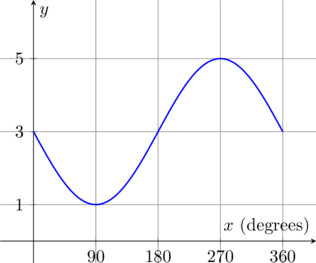
Solution for (ii)
[su_table responsive=”yes” alternate=”no”]
[/su_table]
Solution for (iii)
For a function g(x) to have an inverse, it must be one-to-one (injective) within its domain. This means that the function should be either strictly increasing or strictly decreasing.
Analyze the graph of g(x)
- Decreasing in \(0^{\circ} \leq x \leq 90^{\circ}\)
- Increasing in \(90^{\circ} \leq x \leq 270^{\circ}\)
- Decreasing in \(270^{\circ} \leq x \leq 360^{\circ}\)
\(g(x)\) is strictly decreasing in \(0^{\circ} \leq x \leq 90^{\circ}\). But after \(x = 90^{\circ}\), it starts increasing again, which means it is no longer one-to-one beyond this point.
To ensure that \(g(x)\) is one-to-one, the largest possible A is \(90^{\circ}\).
Thus, the function \(g(x)\) has an inverse if and only if \(0^{\circ} \leq x \leq 90^{\circ}\)
Solution for (iv)
\(g : x \rightarrow 3 \:-\:2\sin x\)
\(y = 3 \:-\:2\sin x\)
\(y\:-\:3 = -2\sin x\)
\(\sin x = -\dfrac{y\:-\:3}{2}\)
\(\sin x = \dfrac{3\:-\:y}{2}\)
\(x = \sin^{-1}\left( \dfrac{3\:-\:y}{2} \right)\)
\(g^{-1}(y) = \sin^{-1}\left( \dfrac{3\:-\:y}{2} \right)\)
\(g^{-1}(x) = \sin^{-1}\left( \dfrac{3\:-\:x}{2} \right)\)
[/showhide]
[su_divider top=”no” size=”1″]
QP 08
[su_table responsive=”yes” alternate=”no”]
[/su_table]
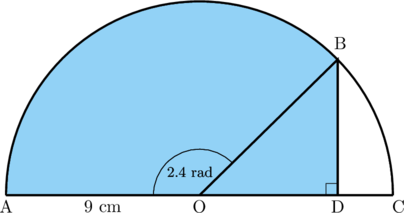
In the diagram, ABC is a semicircle, centre O and radius 9 cm. The line BD is perpendicular to the diameter AC and angle AOB = 2.4 radians.
(i) Show that BD = 6.08 cm, correct to 3 significant figures.
(ii) Find the perimeter of the shaded region.
(iii) Find the area of the shaded region.
[showhide type=”8″ more_text=”Show Solution” less_text=”Hide Solution” hidden=”yes”]
[su_table responsive=”yes”]
Solution for (i)
\(\angle \text{BOD} = (\pi \:-\: 2.4)\text{ rad}\)
In the \(\triangle \text{ BDO}\)
\(\sin {(\pi \:-\: 2.4)} = \dfrac{\text{BD}}{\text{OB}}\)
\(\sin {(\pi \:-\: 2.4)} = \dfrac{\text{BD}}{9}\)
\(\text{BD} = 9 \times \sin {(\pi \:-\: 2.4)}\)
\(\text{BD} = 6.08 \text{ cm}\)
Solution for (ii)
\(\text{Arc AB} = r \times \theta\)
\(\text{Arc AB} = 9 \times 2.4\)
\(\text{Arc AB} = 21.6 \text{ cm}\)
In the \(\triangle \text{ BDO}\)
\(\text{OD} = 9 \times \cos {(\pi \:-\: 2.4)}\)
\(\text{OD} = 6.64 \text{ cm}\)
Perimeter = \(\text{Arc AB} + \text{BD} + \text{OD} + \text{AO}\)
Perimeter = \(21.6 + 6.08 + 6.64 + 9\)
Perimeter = \(43.3 \text{ cm}\)
Solution for (iii)
Area of sector AOB = \(\dfrac{\theta}{2\pi} \times \pi \cdot r^2\)
Area of sector AOB = \(\dfrac{2.4}{2\cancel{\pi}} \times \cancel{\pi} \cdot 9^2\)
Area of sector AOB = \(\dfrac{1}{2} \times 2.4 \cdot 9^2\)
Area of sector AOB = \(97.2 \text{ cm}^2\)
Area of triangle BDO = \(\dfrac{1}{2} \times \text{ OD} \times \text{ BD}\)
Area of triangle BDO = \(\dfrac{1}{2} \times 6.64 \times 6.08\)
Area of triangle BDO = \(20.18 \text{ cm}^2\)
Area of the shaded region = 97.2 + 20.18 ≈ 117 cm²
[/su_table]
[/showhide]
[su_divider top=”no” size=”1″]
QP 09
A curve has equation \(y = \dfrac{4}{\sqrt{x}}\).
(i) The normal to the curve at the point (4, 2) meets the \(x\)-axis at P and the \(y\) axis at Q. Find the length of PQ, correct to 3 significant figures.
(ii) Find the area of the region enclosed by the curve, the \(x\)-axis and the lines \(x = 1\) and \(x = 4\).
[showhide type=”9″ more_text=”Show Solution” less_text=”Hide Solution” hidden=”yes”]
[su_table responsive=”yes”]
Solution for (i)
\(m_{\text{tangent}} = \dfrac{dy}{dx}\)
\(m_{\text{tangent}} = -2x^{-1.5}\) at the point (4, 2)
Substitute \(x = 4\)
\(m_{\text{tangent}} = -2\cdot 4^{-1.5}\)
\(m_{\text{tangent}} = -2\cdot 2^{-3}= – \dfrac{1}{4}\)
\(m_{\text{tangent}} \times m_{\text{normal}} = -1\)
\(- \dfrac{1}{4} \times m_{\text{normal}} = -1\)
\(m_{\text{normal}} = 4\)
Equation of normal line at at the point (4, 2)
\(y\:-\:y_1 = m_{\text{normal}}(x\:-\:x_1)\)
\(y\:-\:2 = 4(x\:-\:4)\)
\(y\:-\:2 = 4x\:-\:16\)
\(y = 4x \:-\:14\)
\(x\)-intercept, \(y = 0\)
\(0 = 4x \:-\:14\)
\(4x = 14\)
\(x = 3.5\)
\(\text{P}(3.5, 0)\)
\(y\)-intercept, \(x = 0\)
\(y= 4(0) \:-\:14\)
\(y = -14\)
\(\text{Q}(0, -14)\)
Length of PQ = \(\sqrt{(x_2\:-\:x_1)^2 + (y_2 \:-\:y_1)^2}\)
Length of PQ = \(\sqrt{(0\:-\:3.5)^2 + (-14 \:-\:0)^2}\)
Length of PQ = \(\sqrt{12.25 + 196}\)
Length of PQ = \(\sqrt{208.25}\)
Length of PQ = 14.4
Solution for (ii)
Area = \(\int_{1}^{4} \dfrac{4}{\sqrt{x}}\text{ dx}\)
Area = \(\left.\frac{4x^{0.5}}{0.5}\right|_1^4\)
Area = \(\left.8\sqrt{x}\right|_1^4\)
Area = \(16\:-\:8\)
Area = 8
[/su_table]
[/showhide]
[su_divider top=”no” size=”1″]
QP 10
The equation of a curve is \(y = x^2 \:-\:3x + 4\)
(i) Show that the whole of the curve lies above the x-axis.
(ii) Find the set of values of \(x\) for which \(x^2\:-\:3x + 4\) is a decreasing function of \(x\).
The equation of a line is \(y + 2x = k\), where \(k\) is a constant.
(iii) In the case where \(k = 6\), find the coordinates of the points of intersection of the line and the curve.
(iv) Find the value of \(k\) for which the line is a tangent to the curve.
[showhide type=”10″ more_text=”Show Solution” less_text=”Hide Solution” hidden=”yes”]
[su_table responsive=”yes”]
Solution for (i)
For the equation \(y = x^2 \:-\:3x + 4\), the coefficients are:
\(a = 1, b = -3, c = 4\)
Now, let’s computer the discrimant:
\(\text{D} = b^2 \:-\:4ac\)
\(\text{D} = (-3)^2 \:-\:4(1)(4)\)
\(\text{D} = 9 \:-\:16\)
\(\text{D} = -7\)
Since the discriminant is negative, the quadratic equation has no real roots, means that the curve does not cross the \(x\)-axis.
The coefficient \(a = 1\) (the coefficient of \(x^2\)) is positive, meaning tha the parabola opens upwards.
Since the discriminant is negative and the parabola opens upwards, the entire curve lies above the \(x\)-axis. Thus, the equation \(y = x^2\:-\:3x + 4\) describes a curve that is always above the \(x\)-axis.
Solution for (ii)
\(y = x^2 \:-\:3x + 4\)
We first compute the first derivative \(\dfrac{dy}{dx}\)
\(\dfrac{dy}{dx} = 2x\:-\:3\)
A function is decreasing where it’s derivative is negative.
\(2x\:-\:3 < 0\)
\(2x < 3\)
\(x < \dfrac{3}{2}\)
\(x < 1.5\)
Thus, the set of values of \(x\) for which the function is decreasing is: \(x \in (-\infty, \frac{3}{2})\)
Solution for (iii)
\(y + 2x = 6 \rightarrow y = 6\:-\:2x\)
Now substitute \(y = 6\:-\:2x\) into the equation \(y = x^2 \:-\:3x + 4\)
\(6\:-\:2x = x^2 \:-\:3x + 4\)
\(0 = x^2 \:-\:x\:-\:2\)
\(0 = (x\:-\:2)(x + 1)\)
\(x = 2 \text{ or } x = -1\)
When \(x = 2\), \(y = 6\:-\:2(2) = 2\)
When \(x = -1\), \(y\:-\:2(-2) = 8\)
The points of intersection are \((2, 2) \text{ and } (-1, 8)\)
Solution for (iv)
\(y + 2x = k\)
Now substitute \(y = k\:-\:2x\) into the equation \(y = x^2 \:-\:3x + 4\)
\(k\:-\:2x = x^2 \:-\:3x + 4\)
\(0 = x^2 \:-\: x + (4\:-\:k)\)
\(\text{D} = b^2\:-\:4ac = 0\)
\((-1)^2 \:-\:4(1)(4\:-\:k) = 0\)
\(1 \:-\:16 + 4k = 0\)
\(-15 + 4k = 0\)
\(4k = 15\)
\(k = \dfrac{15}{4}\)
\(k = 3\dfrac{3}{4}\)
[/su_table]
[/showhide]
[su_divider top=”no” size=”1″]
QP 11
Relative to an origin O, the position vectors of the points A and B are given by
\(\overrightarrow{OA} = 2\textbf{i} + 3\textbf{j} \:-\:\textbf{k}\) and \(\overrightarrow{OB} = 4\textbf{i} \:-\: 3\textbf{j} +2 \textbf{k}\)
(i) Use a scalar product to find angle AOB, correct to the nearest degree.
(ii) Find the unit vector in the direction of \(\overrightarrow{AB}\).
(iii) The point C is such that \(\overrightarrow{OC} = 6\textbf{j} + p\textbf{k}\), where \(p\) is a constant. Given that the lengths of \(\overrightarrow{AB}\) and \(\overrightarrow{AC}\) are equal, find the possible values of \(p\).
[showhide type=”11″ more_text=”Show Solution” less_text=”Hide Solution” hidden=”yes”]
[su_table responsive=”yes”]
Solution for (i)
\(\overrightarrow{OA} = 2\textbf{i} + 3\textbf{j} \:-\:\textbf{k}\)
\(|\overrightarrow{OA}| = \sqrt{2^2 + 3^2 + (-1)^2}\)
\(|\overrightarrow{OA}| = \sqrt{14}\)
\(\overrightarrow{OB} = 4\textbf{i} \:-\: 3\textbf{j} +2 \textbf{k}\)
\(|\overrightarrow{OB}| = \sqrt{4^2 + (-3)^2 + 2^2}\)
\(|\overrightarrow{OB}| = \sqrt{29}\)
\(\cos \theta = \dfrac{\overrightarrow{OA} \cdot \overrightarrow{OB} }{|\overrightarrow{OB}| \cdot |\overrightarrow{OB}| }\)
\(\cos \theta = \dfrac{2\cdot 4 + 3\cdot (-3) + (-1) \cdot 2 }{ \sqrt{14} \cdot\sqrt{29}}\)
\(\cos \theta = \dfrac{-3}{\sqrt{406}}\)
\(\theta = 99^{\circ}\)
Solution for (ii)
\(\overrightarrow{AB} = \overrightarrow{OB}\:-\:\overrightarrow{OA}\)
\(\overrightarrow{AB} = 4\textbf{i} \:-\: 3\textbf{j} +2 \textbf{k}\:-\:(2\textbf{i} + 3\textbf{j} \:-\:\textbf{k})\)
\(\overrightarrow{AB} = 2\textbf{i} \:-\: 6\textbf{j} + 3 \textbf{k}\)
\(|\overrightarrow{AB}| = \sqrt{2^2 + (-6)^2 + 3^2}\)
\(|\overrightarrow{AB}| = \sqrt{4 + 36 + 9}\)
\(|\overrightarrow{AB}| = \sqrt{49} = 7\)
Unit vector AB = \(\dfrac{\overrightarrow{AB}}{|\overrightarrow{AB}| }\)
Unit vector AB = \(\dfrac{2\textbf{i} \:-\: 6\textbf{j} + 3 \textbf{k}}{7}\)
Unit vector AB = \(\dfrac{1}{7} (2\textbf{i} \:-\: 6\textbf{j} + 3 \textbf{k})\)
Solution for (iii)
\(\overrightarrow{OC} = 6\textbf{j} + p\textbf{k}\)
\(\overrightarrow{OA} = 2\textbf{i} + 3\textbf{j} \:-\:\textbf{k}\)
\(\overrightarrow{AC} = \overrightarrow{OC}\:-\:\overrightarrow{OA}\)
\(\overrightarrow{AC} = 6\textbf{j} + p\textbf{k}\:-\:( 2\textbf{i} + 3\textbf{j} \:-\:\textbf{k})\)
\(\overrightarrow{AC} = -2\textbf{i} + 3\textbf{j} + (p + 1)\textbf{k})\)
\(|\overrightarrow{AC}| = |\overrightarrow{AB}|\)
\(\sqrt{(-2)^2 + 3^2 + (p + 1)^2} = 7\)
\(\sqrt{13 + (p + 1)^2} = 7\)
\(13 + (p + 1)^2 = 7^2\)
\((p + 1)^2 = 49\:-\:13\)
\((p + 1)^2 = 36\)
\(p + 1 = \pm 6\)
\(p = 5 \text{ or } p = -7\)
[/su_table]
[/showhide]