QP 01
A curve has equation \(y = \dfrac{k}{x}\). Given that the gradient of the curve is \(-3\) when \(x = 2\), find the value of the constant \(k\).
[showhide type=”1″ more_text=”Show Solution” less_text=”Hide Solution” hidden=”yes”]
[su_table responsive=”yes”]
Gradien of the curve = \(\dfrac{dy}{dx}\)
\(-3 = \dfrac{dy}{dx}\)
\(-3 = -k\cdot x^{-2}\)
Then substitute \(x = 2\)
\(-3 = -k\cdot 2^{-2}\)
\(-3 = -k \cdot \dfrac{1}{2^2}\)
\(-3 = -k \cdot \dfrac{1}{4}\)
\(-12 = -k\)
\(k = 12\)
[/su_table]
[/showhide]
[su_divider top=”no” size=”1″]
QP 02
Solve the equation
\(\sin 2x + 3 \cos 2x = 0,\) for \(0^{\circ} \leq x \leq 180^{\circ}\)
[showhide type=”2″ more_text=”Show Solution” less_text=”Hide Solution” hidden=”yes”]
[su_table responsive=”yes”]
\(\sin 2x + 3 \cos 2x = 0,\)
\(\sin 2x = -3 \cos 2x ,\)
\(\dfrac{\sin 2x}{\cos 2x} = -3\)
\(\tan 2x = -3\)
\(\tan 2x = \tan {-71,6^{\circ}}\)
\(2x = -71,6^{\circ} + k \cdot 180^{\circ}\)
\(x = -35,8^{\circ} + k \cdot 90^{\circ}\)
For \(k = 1 \rightarrow x = 54,2^{\circ}\)
For \(k = 2 \rightarrow x = 144,2^{\circ}\)
Solution \(\lbrace 54,2^{\circ}, 144,2^{\circ}\rbrace\)
[/su_table]
[/showhide]
[su_divider top=”no” size=”1″]
QP 03
Each year a company gives a grant to a charity. The amount given each year increases by 5% of its value in the preceding year. The grant in 2001 was $5000. Find
(i) the grant given in 2011
(ii) the total amount of money given to the charity during the years 2001 to 2011 inclusive.
[showhide type=”3″ more_text=”Show Solution” less_text=”Hide Solution” hidden=”yes”]
[su_table responsive=”yes”]
Solution for (i)
The given problem involves a yearly grant that increases by 5% each year. This forms a geometric progression (GP) where:
- First term \(a = 5000\)
- Ratio (r = 1.05) (since each year the grant increases by 5%)
The grant follows the geometric sequence formula:
\(\text{T}_n = a r^{(n \:-\:1)}\)
Where:
- \(\text{T}_n\) is the grant in year \(n\)
- \(n = 2011 \:-\:2001 + 1 = 11\)
- \(r = 1.05\)
\(\text{T}_n = 5000 \times (1.05)^{10}\)
\(\text{T}_n = 8144.47\)
The grant given in 2011 was approximately $8144
Solution for (ii)
The total amount given over multiple years follows the sum formula for a geometric series
\(S_n = \dfrac{a(r^n \:-\: 1)}{r \:-\:1}\)
Where:
- \(n = 11\)
- \(r = 1.05\)
- \(a = 5000\)
\(S_{11} = \dfrac{5000((1.05)^{11} \:-\: 1)}{1.05 \:-\:1}\)
\(S_{11} =71034\)
The total amunt of money given to the charity from 2001 to 2011 was approximately $71034.
[/su_table]
[/showhide]
[su_divider top=”no” size=”1″]
QP 04
The first three terms in the expansion of \((2 + ax)^n\), in ascending powers of \(x\), are \(32\:-\:40x + bx^2\). Find the values of the constants \(n, a, \text{ and } b\).
[showhide type=”4″ more_text=”Show Solution” less_text=”Hide Solution” hidden=”yes”]
[su_table responsive=”yes”]
The given expansion is: \((2 + ax)^n\)
Expanding using the Binomial Theorem
\((2 + ax)^n = \sum_{k = 0}^n \left(\begin{array}{c}n\\ k\end{array}\right) (2)^{n\:-\:k} (ax)^k\)
The first three terms are given as: \(32\:-\:40x + bx^2\)
The first term is obtained by setting \(k = 0\)
\(T_{0} = \left(\begin{array}{c}n\\0\end{array}\right) (2)^{n\:-\:0} (ax)^0\)
\(32 = 2^n\)
\(2^5 = 2^n\)
\(\color{red} n = 5\)
The second term comes from \(k = 1\)
\(T_{1} = \left(\begin{array}{c}5\\1\end{array}\right) (2)^{5\:-\:1} (ax)^1\)
\(T_{1} = 5 \cdot 16 \cdot ax\)
\(T_{1} = 80ax\)
\(-40x = 80ax\)
\(a = \dfrac{-40x}{80x}\)
\(\color{red} a = -\dfrac{1}{2}\)
The third term comes from \(k = 2\)
\(T_{2} = \left(\begin{array}{c}5\\2\end{array}\right) (2)^{5\:-\:2} (ax)^2\)
\(T_{2} = 10 \cdot 8 \cdot a^2x^2\)
\(bx^2= 10 \cdot 8 \cdot a^2x^2\)
\(b\cancel{x^2}= 10 \cdot 8 \cdot a^2\cancel{x^2}\)
Substituting \(a = -\dfrac{1}{2}\)
\(b = 10 \cdot 8 \cdot \left( -\dfrac{1}{2}\right)^2\)
\(b = 80 \times \dfrac{1}{4}\)
\(\color{red} b = 20\)
[/su_table]
[/showhide]
[su_divider top=”no” size=”1″]
QP 05
The curve \(y^2 = 12x\) intersects the line \(3y = 4x + 6\) at two points. Find the distance between the two points.
[showhide type=”5″ more_text=”Show Solution” less_text=”Hide Solution” hidden=”yes”]
[su_table responsive=”yes”]
Rearrange the line equation:
\(y = \dfrac{4}{3} x + 2\)
Substituting \(y = \dfrac{4}{3} x + 2\) into \(y^2 = 12x\)
\( \left( \dfrac{4}{3} x + 2\right)^2 = 12x\)
Expanding:
\(\dfrac{16}{9}x^2 + \dfrac{16}{3}x + 4 = 12x\)
Multiply both sides by 9
\(16x^2 \:-\:60x + 36 = 0\)
Divide both sides by 4
\(4x^2 \:-\:15x + 9 = 0\)
\((4x\:-\:3)(x\:-\:3) = 0\)
\(4x\:-\:3 = 0 \rightarrow x = \dfrac{3}{4}\)
\(x\:-\:3 = 0 \rightarrow x = 3\)
For \(x = \dfrac{3}{4}\), \(y = \dfrac{4}{3} \cdot \dfrac{3}{4} + 2 = 3\)
For \(x = 3\), \(y = \dfrac{4}{3} \cdot 3 + 2 = 6\)
The two points are: \((3, 6)\) and \((\dfrac{3}{4}, 3)\)
Using distance between two points formula:
\(\color{blue} d = \sqrt{(x_2 \:-\:x_1)^2 + (y_2 \:-\:y_1)^2}\)
\(d = \sqrt{(\frac{3}{4} \:-\:3)^2 + (3 \:-\:6)^2}\)
\(d = \sqrt{(-\frac{9}{4})^2 + (-3)^2}\)
\(d = \sqrt{\dfrac{81}{16} + \dfrac{144}{16}}\)
\(d = \sqrt{\dfrac{225}{16}}\)
\(d = \dfrac{15}{4} = 3.75\)
The distance between the two points is 3.75 units.
[/su_table]
[/showhide]
[su_divider top=”no” size=”1″]
QP 06
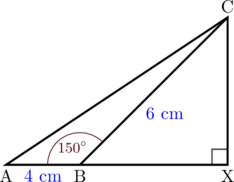
In the diagram, ABC is a triangle in which AB = 4 cm, BC = 6 cm and angle ABC = 150°. The line CX is perpendicular to the line ABX.
(i) Find the exact length of BX and show that angle CAB = \(\tan^{-1} \left(\dfrac{3}{4 + 3\sqrt{3}}\right)\).
(ii) Show that the exact length of AC is \(\sqrt{(52 + 24\sqrt{3})}\) cm.
[showhide type=”6″ more_text=”Show Solution” less_text=”Hide Solution” hidden=”yes”]
[su_table responsive=”yes”]
Solution (i)
\(\angle \text{CBX} = 180^{\circ} \:-\: 150^{\circ} = 30^{\circ}\)
In the triangle CXB,
\(\cos 30^{\circ} = \dfrac{\text{BX}}{\text{BC}}\)
\(\dfrac{1}{2}\sqrt{3} = \dfrac{\text{BX}}{6}\)
\(\color{red} \text{BX} = 3\sqrt{3} \text{ cm}\)
\(\sin 30^{\circ} = \dfrac{\text{CX}}{\text{BC}}\)
\(\dfrac{1}{2} = \dfrac{\text{CX}}{6}\)
\(\text{CX} = 3 \text{ cm}\)
In the triangle AXB,
\(\tan \angle \text{CAX} = \dfrac{\text{CX}}{\text{AX}}\)
\(\tan \angle \text{CAX} = \dfrac{3}{4 + 3\sqrt{3}}\)
\(\angle \text{CAX} = \angle \text{CAB} = \tan^{-1} \left(\dfrac{3}{4 + 3\sqrt{3}} \right)\)
Solution (ii)
In the triangle AXC
Use Pythagorean Theorem
\(\text{AC}^2 = \text{AX}^2 + \text{CX}^2\)
\(\text{AC}^2 = (4 + 3\sqrt{3})^2 + 3^2\)
\(\text{AC}^2 = 16 + 24\sqrt{3} + 27 + 9\)
\(\text{AC}^2 = 52 + 24\sqrt{3}\)
\(\color{red} \text{AC} = \sqrt{ 52 + 24\sqrt{3}} \text{ cm}\)
[/su_table]
[/showhide]
[su_divider top=”no” size=”1″]
QP 07
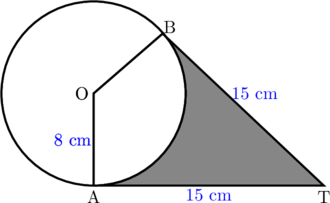
The diagram shows a circle with centre O and radius 8 cm. Points A and B lie on the circle. The tangents at A and B meet at the point T, and AT = BT = 15 cm.
(i) Show that angle AOB is 2.16 radians, correct to 3 significant figures.
(ii) Find the perimeter of the shaded region.
(iii) Find the area of the shaded region.
[showhide type=”7″ more_text=”Show Solution” less_text=”Hide Solution” hidden=”yes”]
[su_table responsive=”yes”]
Solution (i)
In the triangle OAT
\(\tan \frac{1}{2} \theta = \dfrac{\text{AT}}{\text{AO}}\)
\(\tan \frac{1}{2} \theta = \dfrac{15}{8}\)
\(\frac{1}{2} \theta = \tan^{-1} \left(\dfrac{15}{8}\right)\)
\(\frac{1}{2} \theta = 61.9^{\circ}\)
\(\theta = 124^{\circ}\)
\(\theta = 124^{\circ} \times \dfrac{\pi}{180^{\circ}}\)
\(\theta = 124^{\circ} \times \dfrac{3,14}{180^{\circ}}\)
\(\theta = 2.16 \text{ rad}\)
Solution (ii)
Perimeter of the shaded region = arc AB + AT + BT
Perimeter of the shaded region = \(\theta \cdot r\) + 15 + 15
Perimeter of the shaded region = \(2.16 \cdot 8\) + 15 + 15
Perimeter of the shaded region = 47.28 cm
Solution (iii)
Area of the shaded region = area of kite OATB − area of sector AOB
Area of the shaded region = (2 × area ΔOAT) − area of sector AOB
Area of the shaded region = (2 × ½ × 15 × 8) − \(\dfrac{\theta}{2\pi} \cdot \pi r^2\)
Area of the shaded region = 120 − \(\dfrac{2.16}{2} \cdot 8^2\)
Area of the shaded region = 120 − 69.12
Area of the shaded region = 50.9 cm²
[/su_table]
[/showhide]
[su_divider top=”no” size=”1″]
QP 08
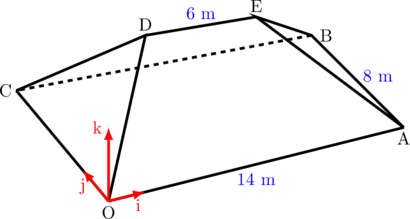
The diagram shows the roof of a house. The base of the roof, OABC, is rectangular and horizontal with OA = CB = 14 m and OC = AB = 8 m. The top of the roof DE is 5 m above the base and DE = 6 m. The sloping edges OD, CD, AE and BE are all equal in length.
Unit vectors i and j are parallel to OA and OC respectively and the unit vector k is vertically upwards.
(i) Express the vector \(\overrightarrow{\text{OD}}\) in terms of i, j, and k, and find its magnitude.
(ii) Use a scalar product to find angle DOB.
[showhide type=”8″ more_text=”Show Solution” less_text=”Hide Solution” hidden=”yes”]
[su_table responsive=”yes”]
Solution for (i)
\(\overrightarrow{\text{OD}} = 4 \textbf{i} + 4 \textbf{j} + 5 \textbf{k}\)
\(|\overrightarrow{\text{OD}}| = \sqrt{4^2 + 4^2 + 5^2}\)
\(|\overrightarrow{\text{OD}}| = \sqrt{57}\)
\(|\overrightarrow{\text{OD}}| = 7.55 \text{ m}\)
Solution for (ii)
\(\overrightarrow{\text{OB}} = 14\textbf{i} + 8 \textbf{j}\)
\(\overrightarrow{\text{OD}}\cdot \overrightarrow{\text{OB}} = (4\times 14) + (4 \times 8) = 88\)
\(\overrightarrow{\text{OD}}\cdot \overrightarrow{\text{OB}} =|\overrightarrow{\text{OD}}| \cdot |\overrightarrow{\text{OB}}| \cdot \cos \theta\)
\(88 = \sqrt{57} \cdot \sqrt{260} \cos \theta\)
\(\angle \text{ DOB} = 43.7^{\circ}\)
[/su_table]
[/showhide]
[su_divider top=”no” size=”1″]
QP 09
A curve is such that \(\dfrac{dy}{dx} = \dfrac{4}{\sqrt{(6\:-\:2x)}}\), and \(\text{P(1, 8)}\) is a point on the curve.
(i) The normal to the curve at the point P meets the coordinate axes at Q and at R. Find the coordinates of the mid-point of QR.
(ii) Find the equation of the curve
[showhide type=”9″ more_text=”Show Solution” less_text=”Hide Solution” hidden=”yes”]
[su_table responsive=”yes”]
Solution for (i)
Finding the coordinates of the midpoint of QR
The given differential equation is \(\dfrac{dy}{dx} = \dfrac{4}{\sqrt{6\:-\:2x}}\)
At the point P(1, 8), we compute the gradient of the tangent:
\(m_{\text{tangent}} = \dfrac{4}{\sqrt{6\:-\:2(1)}}\)
\(m_{\text{tangent}} = \dfrac{4}{\sqrt{4}}\)
\(m_{\text{tangent}} = 2\)
Since the normal is perpendicular to the tangent, its slope is the negative reciprocal:
\(m_{\text{tangent}} \cdot m_{\text{normal}} = -1\)
\(2 \cdot m_{\text{normal}} = -1\)
\(m_{\text{normal}}= -\dfrac{1}{2}\)
The equation of the normal at P(1, 8) is:
\(y\:-\:y_1 = m_{\text{normal}} (x\:-\:x_1)\)
\(y\:-\:8 = -\dfrac{1}{2} (x\:-\:1)\)
\(y = -\dfrac{1}{2}x + \dfrac{17}{2}\)
Finding the x-intercept (Q)
Set \(y = 0\)
\(0 = -\dfrac{1}{2}x + \dfrac{17}{2}\)
\(\dfrac{1}{2}x =\dfrac{17}{2}\)
\(x = 17\)
So, \(\text{Q}(17, 0)\)
Finding the y-intercept (R)
Set \(x = 0\)
\(y = -\dfrac{1}{2}(0) + \dfrac{17}{2}\)
\(y = \dfrac{17}{2}\)
So, \(\text{R}(0, \frac{17}{2})\)
Finding the midpoint of QR
The midpoint M is:
M = \(\left(\dfrac{17 + 0}{2}, \dfrac{0 + \frac{17}{2}}{2}\right)\)
M = \(\left(\dfrac{17}{2}, \dfrac{17}{4}\right)\)
Solution for (ii)
Finding the equation of the curve
\(dy = \dfrac{4}{\sqrt{6\:-\:2x}} dx\)
\(\int dy = \int \dfrac{4}{\sqrt{6\:-\:2x}} dx\)
Use substitution:
\(u = 6\:-\:2x \rightarrow \dfrac{du}{dx} = -2\)
Rewrite the integral:
\(\int dy = \int \dfrac{4}{\sqrt{u}} \cdot \dfrac{du}{-2}\)
\(\int dy = -2\int u^{-\frac{1}{2}} du\)
\(y = -2 \cdot (2u^{\frac{1}{2}} + C\)
\(y = -4\sqrt{u} + C\)
\(y = -4\sqrt{6\:-\:2x} + C\)
Use the point P(1, 8) to find C:
\(8 = -4\sqrt{6\:-\:2(1)} + C\)
\(8 = -4\sqrt{4} + C\)
\(8 = -8 + C\)
\(C = 16\)
Thus, the equation of the curve is:
\(y = -4\sqrt{6 \:-\:2x} + 16\)
[/su_table]
[/showhide]
[su_divider top=”no” size=”1″]
QP 10
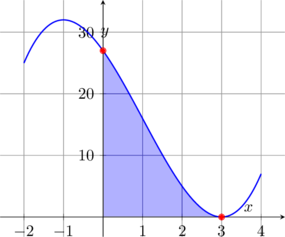
The diagram shows the curve \(y = x^3 \:-\:3x^2\:-\:9x + k\), where \(k\) is a constant. The curve has a minimum point on the \(x\)-axis.
(i) Find the value of \(k\).
(ii) Find the coordinates of the maximum point of the curve.
(iii) State the set of values of \(x\) for which \(x^3 \:-\:3x^2 \:-\:9x + k\) is a decreasing function of \(x\).
(iv) Find the area of the shaded region.
[showhide type=”10″ more_text=”Show Solution” less_text=”Hide Solution” hidden=”yes”]
[su_table responsive=”yes”]
Solution for (i)
Finding the value of \(k\)
\(y = x^3 \:-\:3x^2 \:-\:9x + k\)
to find the minimum point, we first differentiate:
\(\dfrac{dy}{dx} = 3x^2 \:-\:6x \:-\:9\)
Critical points, \(\dfrac{dy}{dx} = 0\)
\(3x^2\:-\:6x\:-\:9 = 0\)
Dividing by 3:
\(x^2 \:-\:2x \:-\:3 = 0\)
Factorizing:
\((x\:-\:3)(x + 1) = 0\)
So, the critical points are \(x = 3\) and \(x = -1\).
The minimum point is given as lying on the \(x\)-axis, meaning \(y = 0\) at \(x = 3\):
\(0 = 3^3 \:-\:3(3^2) \:-\:9(3) + k\)
\(0 = 27\:-\:27 \:-\:27 + k\)
\(0 = -27 + k\)
\(\color{red} k = 27\)
Solution for (ii)
Finding the coordinates of the maximum point
From part (i), the critical points are \(x = 3\) and \(x = -1\).
To determine which is the maximum, we compute the second derivative:
\(\dfrac{d^2y}{dx^2} = 6x\:-\:6\)
At \(x = 3\)
\(\dfrac{d^2y}{dx^2} = 6(3)\:-\:6 = 12\)
(positive, so \(x = 3\) is a minimum)
At \(x = -1\)
\(\dfrac{d^2y}{dx^2} = 6(-1)\:-\:6 = -12\)
(negative, so \(x = -1\) is a maximum)
Now, we find the \(y\)-coordinate of the maximum point by substituting \(x = -1\) into \(y = x^3 \:-\:3x^2 \:-\:9x + 27\)
\(y = (-1)^3 \:-\:3(-1)^2\:-\:9(-1) + 27\)
\(y = -1\:-\:3 + 9 + 27\)
\(y = 32\)
Thus, the maximum point is \((-1, 32)\)
Solution for (iii)
Finding the set of values where the function is decreasing
A function is decreasing where \(\dfrac{dy}{dx} < 0\)
\(3x^2 \:-\:6x \:-\:9 < 0\)
Dividing by 3:
\(x^2 \:-\:2x \:-\:3 < 0\)
Factorizing:
\((x \:-\:3)(x + 1) < 0\)
Using a sign table, the expression is negative between the roots:
\(\lbrace -1 < x < 3 \rbrace\)
Thus, the function is decreasing for \(x \in (-1, 3)\)
Solution for (iv)
Area = \(\int_{0}^{3} (x^3\:-\:3x^2 \:-\:9x + 27) dx\)
Area = \(\left.\dfrac{1}{4}x^4 \:-\:\dfrac{3}{3}x^3\:-\:\dfrac{9}{2}x^2 + 27x\right|_0^3\)
Area = \(\dfrac{1}{4}(3)^4 \:-\:3^3 \:-\:\dfrac{9}{2}(3)^2 + 27(3)\)
Area of the shaded region = 33.75 square unit
[/su_table]
[/showhide]
[su_divider top=”no” size=”1″]
QP 11
Function \(f\) and \(g\) are defined by
\(f : x \rightarrow k\:-\:x\) for \(x \in \text{R}\), where \(k\) is a constant,
\(g : x \rightarrow \dfrac{9}{x + 2}\) for \(x \in \text{R}, x \neq 2\)
(i) Find the values of \(k\) for which the equation \(f(x) = g(x)\) has two equal roots and solve the equation \(f(x) = g(x)\) in these cases.
(ii) Solve the equation f(g(x)) = 5, when \(k = 6\)
(iii) Express \(g^{-1}(x)\) in terms of \(x\)
[showhide type=”11″ more_text=”Show Solution” less_text=”Hide Solution” hidden=”yes”]
[su_table responsive=”yes”]
Solution for (i)
Find the values of \(k\) for which \(f(x) = g(x)\) has two equal roots and solve the equation.
\(k\:-\:x = \dfrac{9}{x + 2}\)
\((k\:-\:x)(x + 2) = 9\)
\(kx + 2x \:-\:x^2 \:-\:2x = 9\)
\(-x^2 + (k\:-\:2)x + (2k\:-\:9) = 0\)
For the equation to have two equal roots, the discriminant must be zero:
\((k\:-\:2)^2 \:-\:4(-1)(2k\:-\:9) = 0\)
\((k\:-\:2)^2 + 8k \:-\:36 = 0\)
Expanding:
\(k^2\:-\:4k + 4 + 8k\:-\:36 = 0\)
\(k^2 + 4k \:-\:32 = 0\)
\((k\:-\:4)(k + 8) = 0\)
\(k = 4 \text{ or } k = 8\)
Solving for \(x\) when \(k = 4\) or \(k = -8\)
For equal roots, use the quadratic formula:
\(x = \dfrac{-(k \:-\:2)}{2(-1)}\)
\(x = \dfrac{k\:-\:2}{2}\)
For \(k = 4\);
\(x = \dfrac{4\:-\:2}{2} = 1\)
For \(k = -8\);
\(x = \dfrac{-8\:-\:2}{2} =-5\)
Thus, the equation \(f(x) = g(x)\) has equal roots at:
- \(x = 1 \text{ when } k = 4\)
- \(x = -5 \text{ when } k = -8\)
Solution for (ii)
Solve \(f(g(x)) = 5\) when \(k = 6\)
\(f(g(x)) = 6\:-\:g(x) = 5\)
\(6\:-\:\dfrac{9}{x + 2} = 5\)
\(6\:-\:5 = \dfrac{9}{x + 2}\)
\(1 = \dfrac{9}{x + 2}\)
Multiply both sides by \(x + 2\)
\(x + 2 = 9\)
\(x = 7\)
Thus, the solution is \(x = 7\)
Solution for (iii)
Find \(g^{-1}(x)\) in terms of \(x\)
We set \(y = g(x)\)
\(y = \dfrac{9}{x + 2}\)
Solve for \(x\) in terms of \(y\)
\(y(x + 2) = 9\)
\(yx + 2y = 9\)
\(yx = 9 \:-\:2y\)
\(x = \dfrac{9\:-\:2y}{y}\)
Thus, the inverse function is:
\(g^{-1}(x) = \dfrac{9\:-\:2x}{x},\: x \neq 0\)
[/su_table]
[/showhide]